














Project  Stories

Chugai Life Science Park Yokohama
Building a research center
where bold ambition and sense of purpose
continually drive the future of drug discovery.
Project start

Working closely with the customer to build a world-class drug discovery research center: The perfect "water partnership"Working closely with the customer to build a world-class drug discovery research center: The perfect "water partnership"Working closely with the customer to build a world-class drug discovery research center: The perfect "water partnership"

Chugai Pharmaceutical is a research-and-development-oriented pharmaceutical company that develops innovative pharmaceuticals. In order to further accelerate pharmaceutical research and development, the company reached the decision to build "Chugai Life Science Park Yokohama." One of the leading research locations in Japan, this world-class, large-scale facility is far more than two research facilities combined into one.

The mission here is to explore uncharted territory to develop new therapeutic drugs, and then to provide patients all over the world with the drugs they need. In order to accomplish this, Chugai Pharmaceutical placed a strong emphasis on "water." The purity of the water used for drug discovery plays a crucial role in determining how reproducible and accurate research is, and properly treating water discharged during the research process is an important step in reassuring society and earning trust.

An infrastructure for handling feed water and wastewater is essential for drug discovery research, and the water professionals at Organo were chosen for this complex task. In this project story, we take a look at the challenges Organo faced at the site, in working as a steadfast partner of Chugai Pharmaceutical.

Project Members
  • Photo of Hiroki Fukazawa

    Hiroki Fukazawa

    Fukazawa participated in the project beginning in 2019. He served as the sales representative during the design and construction phases.

  • Photo of Masaki Kobata

    Masaki Kobata

    Kobata participated in the project beginning in 2021. He served as the sales representative during the later stages of construction, and was the primary person responsible for equipment operations once the site began operating.

  • Photo of Ayako Honda

    Ayako Honda

    Honda participated in the project beginning in 2021, after completing training at the site. She was responsible for sales duties once the site began operating.

  • Photo of Fumiya Futami

    Fumiya Futami

    Futami participated in the project beginning in 2020. He was responsible for designing the plant for the integrated water treatment facilities.

  • Photo of Takatsugu Komine

    Takatsugu Komine

    Komine participated in the project beginning in 2017, during the planning phase. He was responsible for the overall design and served as project manager.

  • Photo of Shigeaki Wada

    Shigeaki Wada

    Wada participated in the project beginning in 2019. He was responsible for providing installation and operational support for tabletop ultrapure water systems.

Focus 1

A project of an unprecedented scale...
How to find the "optimal solution?"

It all began with sharing the same vision of the future with Chugai Pharmaceutical

It all began several years ago. Takatsugu Komine, one of Organo’s employees, was contacted by Yoshinori Nakajima of Chugai Pharmaceutical about the construction of a massive research facility. It would serve as a location to bring the company's basic research on drug discovery to the next level and ensure that the company could continue to engage in advanced research. Komine immediately realized why Nakajima had contacted him: "Water treatment would become one of the facility's key foundations." Broadly defined, there were four major themes to address as water professionals. The first three were stable operation so that research is never stopped, high quality to ensure research findings, and expandability to handle the evolving nature of research. Added to these would be strict environmental risk measures that would need to be taken due to the urban location.

"I was facing a huge project, the likes of which I'd never experienced before. I needed to keep the whole picture in mind while at the same time figuring out how we could accomplish each task,” Komine recalls. “I decided to focus on the future instead of the present, and to share that with our customers at Chugai Pharmaceutical." Sharing is not simply communicating information. It means engaging in dialogue with customers to gain insight, and advancing the project while presenting specific plans that exceed expectations. ​

"This required creativity and the ability to get work done," Komine says. That meant proposing comprehensive solutions such as installing and operating equipment, as well as plans that incorporated solutions designed to address potential issues. Komine ran through various scenarios in his head to determine what needed to be done and how it should be done, and who to assign to which roles, in order to move the project forward. ​

Engaging young talent in the right roles

Once the project had been given the go-ahead and work started, Komine began adding people to the project. Fumiya Futami (engineering) and Hiroki Fukazawa (sales) joined the team during the design phase. Futami is an engineer with extensive experience in designing plants for wastewater treatment facilities, and is highly skilled at communicating concepts to customers. Fukazawa was working overseas in charge of an international project, but was called back to Japan once the Chugai Pharmaceutical project had launched.

Once the project reached the stage where operations were being considered, Masaki Kobata and Ayako Honda, both from sales, joined the team. Kobata has extensive experience in field sales work, while Honda was a new hire who joined the team after receiving on-site training in the project shortly after joining the company. We asked these young Organo employees how it felt to be at the forefront of this unprecedentedly large project.

Fukazawa

Fukazawa

"Chugai Pharmaceutical has a preparation room in front of Totsuka Station, and I joined the team right when they were about to start going over the details. What we had to do had already been determined quite extensively, so I went to meet with our customers on site. I recall feeling a sense of pride and the strong desire to accomplish our mission. Many research buildings would need to be built together at the same time, so I felt some pressure, but also a strong sense of responsibility to ensure that construction would proceed on time."

Futami

Futami

"For this project, we would be installing plants for wastewater treatment facilities indoors, and this was a new experience for me. The design needed to consider not only bringing equipment in, but also taking equipment out as it was replaced. I applied what I had learned in my work with outdoor plants, and ran through simulations over and over while looking at the drawings."

Kobata

Kobata

"Ensuring that equipment operates properly is extremely important so that researchers can focus on research without worrying about the equipment. There isn't much precedent for work supporting water treatment operations, even at Organo, so Ayako and I worked as a team to ensure that we could deliver the level of reliability our customers required."

Honda

Honda

"It took a lot of effort just to get used to the scale of the project. We needed to figure out what needed to be done to ensure that all of the equipment would continue to operate reliably. I decided to take it day by day and tackle issues one at a time."

Focus 2

Tackling challenges
with unwavering professionalism

A passion for wastewater treatment without compromise

None of the project members had ever handled a project of such a massive scale, and the comprehensive functionality that would be provided by the research facility made many aspects of the project difficult to imagine. Of particular concern was wastewater treatment. Research would continue to evolve even after construction was complete, making it impossible to know what kind of wastewater would be discharged, what its water quality would be, or in what volume.

Project members gathered wastewater samples from Chugai Pharmaceutical's research facilities in Gotemba and Kamakura, compared them with water and sewage standards set by the local government, and through this process were able to estimate the quality and volume of wastewater that would be discharged, with an eye to future-proofing the project against future research trends. Futami, who designed the wastewater treatment plant, recalled, "I met with the people at Chugai Pharmaceutical to discuss in detail their expansion plans for the future, and this is what allowed me to finally get an idea of the wastewater quality and volume. Still, there were a lot of unknowns. That's why I decided to come up with a forward-thinking design. For example, my plan called for installing tanks capable of holding twice the amount of discharge our estimates called for, adding functionality to support any increases in the amount of material treated, and installing more monitoring instruments than usual."

There was a reason why everyone was so focused on ensuring proper wastewater treatment. Chugai Life Science Park Yokohama is located next to a residential area, and must take steps to ensure that wastewater exceeding standard limits is never released into the surrounding area. Chugai Pharmaceutical releases information as an effort to reassure nearby residents that the facility is operating safely. One of Organo’s core missions is to meet expectations for zero environmental risks. In fact, wastewater already met the required standards at the time that the construction requirements were being determined. Even so, Chugai Pharmaceutical wanted to improve this even further, showing their commitment to safety.

The project slogan: "Research must never be stopped"

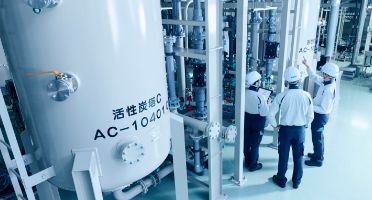
Another significant challenge was to ensure that equipment continues to operate reliably. Even the slightest issue with feed water or wastewater would stop research. The top priority was to ensure that equipment would never stop operating, so that researchers could dedicate themselves to research without having to worry about equipment. It was the Organo team that suggested online operation, which would allow equipment and devices to be monitored remotely. Monitoring operation data and water quality data for the many devices installed throughout the spacious facility, accurately and in real time, could significantly improve operation efficiency and accuracy.

"Monitors installed throughout the plant and on each ultrapure water system continuously track their operating status, helping to prevent problems before they occur,” explains Kobata. “If an issue does occur, we can go check it out as soon as possible. There are also dedicated personnel on site to respond immediately."

Fukazawa continues: "We approach operations management with the understanding that it is at the core of Chugai Pharmaceutical's site management. We always maintain a professional mindset and recognize the important role we've been given in ensuring the research is never stopped, and approach our work with the desire to help our customers fulfill their corporate social responsibilities for the environment."

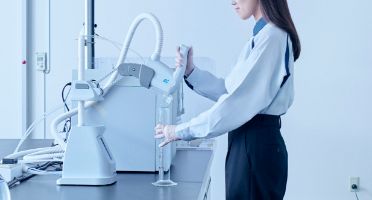
The more than 100 ultrapure water systems located in the various research labs were installed "individually and under sinks," with an eye toward future expandability for the research labs. Another option would have been to install piping for each structure, but this would have reduced flexibility. Project members held meetings with Chugai Pharmaceutical personnel to discuss how research might change over time and what devices might be installed in the future. Drawing upon what they had learned so far, the full picture of the facility came gradually into view. Organo now prepares and supplies all industrial water at Chugai Life Science Park Yokohama, including the ultrapure water used for research and the water used for air conditioning.

Research Facilities & Environment Group, Research Enablement & Operations Dept.
Chugai Pharmaceutical
Yoshinori Nakajima
Research Facilities & Environment Group, Research Enablement & Operations Dept.
Chugai Pharmaceutical
Yoshinori Nakajima

Focus 3

What it means to truly become a partner
for an evolving research facility

Work on the project continues, to ensure that research remains on the cutting edge

It is said that it takes from 10 to 15 years from when seeds are first discovered during basic research until a new drug can be released to market. There were still many difficulties to overcome at Chugai Life Science Park Yokohama, in order for researchers to navigate this lengthy process, overcome the many difficult hurdles they encounter, and focus on research. Below, each member of the project team provides their thoughts on remaining environmentally conscious, considering an unpredictable future, and ensuring that research is never stopped, and talks briefly about the sense of accomplishment they felt during the project.

Fukazawa

Fukazawa

"The facility was constructed during the COVID-19 pandemic, so coordinating the project was even more complicated than usual. There were multiple general contractors and subcontractors working on the project, but we all came together thanks to Chugai Pharmaceutical's clear message that water is a crucial part of the infrastructure of the facility. We were able to get it done without any major accidents or delays, which really gave us a sense of accomplishment."

Kobata

Kobata

"We ran a trial operation once the equipment had been installed, and we kept encountering minor issues, though they could be resolved by making some adjustments. These weren't severe issues, but we needed to address them before the facility went online. We didn't have a lot of time to spare, so our primary focus immediately prior to the facility going online was this process of sharing information with Chugai Pharmaceutical and resolving each issue one by one."

Honda

Honda

"At first, I remember attending meetings and not really understanding what was being discussed. It took some time, but gradually it started to make sense. Now, I'm always thinking about the best way to get customers to voice their concerns. We hold regular meetings with them, where I serve as moderator and hope to use my communication skills along with my ability to understand the technical considerations at hand."

Futami

Futami

"As an engineer, I feel truly grateful to have played a part in the construction of this urban research facility equipped with cutting-edge equipment. I believe that communicating closely with Hiroki and the rest of the sales team is what allowed us to get this done on such a strict schedule. Although the engineering team is responsible for explaining technical concepts to customers, a sales team with a deep understanding of the project definitely makes collaboration easier."

Echoing Futami, Fukazawa adds, "I believe that it's the job of the sales team to listen to the customer and determine what they're really trying to tell you, and then to communicate this to the engineering team, with your own thoughts included, of course. That's why I believe it's important, whenever possible, to visit the site and discuss things while looking at the same situation as the customer." Listening to the younger talent that has driven the project, Komine feels progress has been made. "Lately, the meetings have been running smoothly, even when I'm not present,” he says. “That just shows how much all the people on the team have grown, and how they've earned Chugai Pharmaceutical's trust."

In closing, we asked Chugai Pharmaceutical for some comments on the project.

Yasuhiro Kishi - Research Facilities & Environment Group, Research Enablement & Operations Dept.

"We were all working toward the same goals, and everyone at Organo worked very closely with us. That's what made it a success. They've really become indispensable partners for us. I hope they'll continue to understand what we need and offer fresh suggestions."

Yoshinori Nakajima - Research Facilities & Environment Group, Research Enablement & Operations Dept.

"Our project to create a cutting-edge drug discovery research facility doesn't end here. We need to continue to be on the cutting edge. What we research will change, and I hope to continue to work with Organo in ensuring that our research facility continues to evolve."

Masatake Takei - Research Facilities & Environment Group, Research Enablement & Operations Dept.

"Beginning from the design phase, I'd contact Organo with my questions and ask them to explain their logic and the rationale for the design. They always responded appropriately and in a manner that was easy to understand, which was a great help. They also respond quickly to operational issues, which makes day-to-day management a lot easier."

Research Facilities & Environment Group, Research Enablement & Operations Dept.
Chugai Pharmaceutical
Research Facilities & Environment Group, Research Enablement & Operations Dept.
Chugai Pharmaceutical

Project overview

■ Facility

:

Chugai Life Science Park Yokohama

■ Period

:

2019 to 2023

■ Equipment supplied

:

1.Integrated water treatment facilities system: Advanced filtration equipment (1 million L of water produced per day), RO membrane-type pure water equipment for pure steam, filtration equipment and environmentally friendly equipment for rainwater use, wastewater treatment facilities, multifunctional wastewater treatment including deactivation processing, emergency wastewater tank (300,000 L capacity)
2.Pure water systems for air conditioning and humidification inside the research building: Approx. 40
3.Ultrapure water systems installed individually and under sinks: More than 100 total