



















Material IssuesMaterial Issues
Five Material IssuesFive Material IssuesFive Material Issues
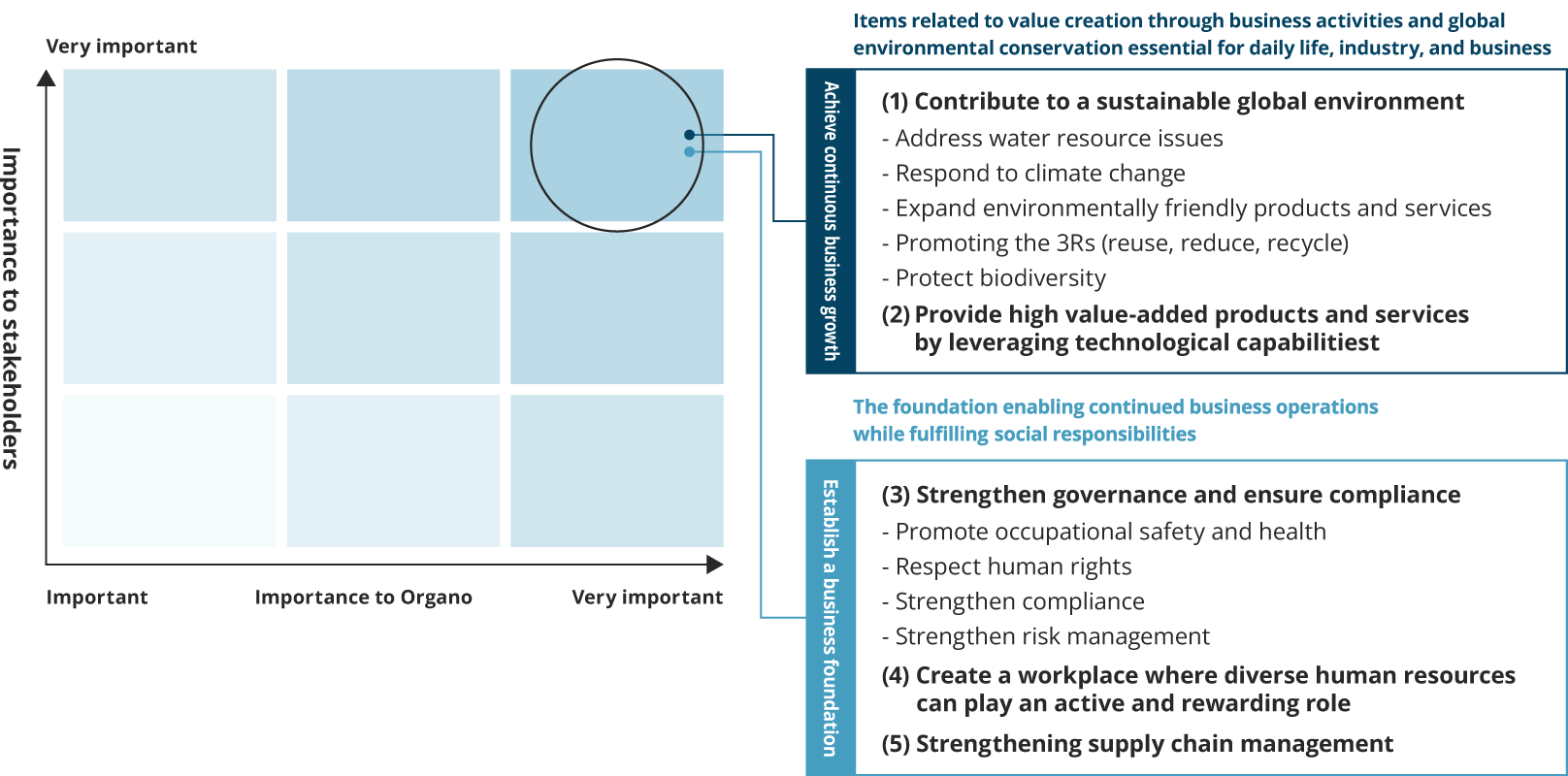
We have identified five material issues aimed at solving social issues while maintaining continuous growth. We continue to create value with our stakeholders through engaging in priority areas such as environmental conservation, talent, and governance.
Achieve continuous business growth
Efforts related to creating value through global environmental preservation and business activities necessary for daily life, industry, and business
- Contribute to a sustainable global environment

- Provide high value-added products and services by leveraging technological capabilities

Establish a business foundation
Foundational efforts to achieve business continuity while achieving corporate social responsibility (CSR)
- Strengthen governance and ensure compliance

- Create a workplace where diverse human resources can play an active and rewarding role

- Strengthen supply chain management

KPIs to Resolve Social Issues and Results of Activities
We have set KPIs for each of our five material issues, and continue to make steady progress toward achieving our targets and delivering results. By delivering measurable results through initiatives aimed at resolving social issues, we are driving the creation of sustainable value for the future.
Scope of data: In principle, domestic and overseas group companies, but for exceptions, scope of data is listed for individual items
- Material Issues
- Contribute to a sustainable global environment
- Provide high value-added products and services by leveraging technological capabilities
- Strengthen governance and ensure compliance
- Create a workplace where diverse human resources can play an active and rewarding role
- Strengthen supply chain management
- Address water resource issues
- Protect biodiversity
- Respond to climate change
- Expansion of environmentally friendly products and services
- Promotion of the 3Rs
- Promote occupational safety and health
- Strengthen compliance
- Respect human rights
- Strengthen risk management
- Key performance indicator (KPI)
- Amount of wastewater treated by newly delivered Organo systems and discharged by plants
- Amount of water collected and reused by newly delivered Organo systems
- Rate of reduction of Scope 1 and 2 CO₂ emissions according to science-based target (SBT) presentation method*1
- Rate of reduction of Scope 3 CO₂ emissions according to science-based target (SBT) presentation method*1
- Volume of CO₂ reduced by applying Organo technology and products
- Volume of sludge reduced by applying Organo technology and products
- Number of developed environmentally friendly products and services that add value by solving customer’s sustainability issues
- Number of serious lost-time injuries*3
- Completion rate of compliance-related training for participants enrolled at the end of the previous fiscal year
- Completion rate of human-rights related training for participants enrolled at the end of the previous fiscal year
- PDCA implementation rate for key risks identified by the Company
- Number of females in managerial positions (domestic group companies)
- Training expense per employee (all group employees including those overseas)
- Number of employees exceeding the annual legal overtime limit*4
* Domestic group companies only - Number of main suppliers compliant with CSR promotion guidebook
- Reference year
- 2023
- 2023
- 2021
- 2021
- 2023
- 2023
- 2023
- 2022
- 2022
- 2022
- 2022
- 2022
- 2022
- 2022
- 2022
- Goals for FY2030
- Total
60 million m3 - Total
250 million m3 - 42% total emissions reduction
(compared with reference year) - 20% reduction in GHG emissions per gross profit
(compared with reference year) - Total
32,000 t-CO₂ - Total
10,000 t - 2 per year
- 0 per year
- 100%
- 100%
- 100%
- 50 employees
- ¥100,000
per person - Employees with 600 hours per year: 0
- Number of companies in compliance: 300 or more
- Results for FY2025
- Total
31,954,582 m3 - Total
52,294,937 m3 - 41% reduction*2
- 28% reduction*2
- Total
8,181 t-CO₂ - Total
7,488 t - 2 per year
(Organo only) - Number of serious lost-time injuries: 4
- Of the 50 required courses, 40 courses had a 100% completion rate, and 10 courses had less than a 100% completion rate
- Completion rate of human-rights related training: 100%
(Target: Organo, domestic group companies) - 100% implementation
- 30 employees
- ¥102,333
per person - Employees with 600 hours per year: 1
- Number of companies in compliance: 223
- ※1Criteria for calculating carbon dioxide emissions set forth by the Science Based Targets initiative (SBTi), an initiative requiring companies to set science-based carbon emission reduction targets.
- ※2The scope of the calculations is based on the consolidated group of companies in FY2025. As PT. Lautan Organo Water was excluded from the consolidated group at the beginning of FY2025, its emissions are not included in the FY2025 figures.
In light of this change, the GHG emissions for the reference year have been adjusted based on the current scope of the calculations, and the reduction rates have been recalculated.
Additionally, the GHG emissions figures for the reference year have been updated with regard to Scope 3 to reflect the enhanced accuracy of the collected data.
In addition, Scope 3 GHG emissions have been revised for the base year to reflect improvements in data accuracy. - ※3Four or more days out of work
- ※4This does not indicate that the upper limit (special clause) stipulated in Agreement 36 has been exceeded
Identification Process
- Keyword extraction
- Assessment of
importance - Assessment of validity
- Identification of material issuesIdentification of material issuesIdentification of material issues
- Extracted candidates for material issues from management philosophy, long-term management vision, ORGANO 2030 (long-term management plan), medium-term management plan, business strategies, business environment, ESG valuation standards, GRI Standards (international guidelines related to sustainability)
- Organized the extracted material issue candidates by "achieving continuous business growth" and "establishing a business foundation," in accordance with the framework of ORGANO 2030, assessed these in terms of the importance to the Company based on the relationship with stakeholders, risks and opportunities, value of providing products and services, and contribution to social issues, and hypothesized material issues
- Assessed validity through discussions with the Sustainability Implementation Meeting and Sustainability Committee and through interviews with outside experts
- Board of Directors determined the material issues
Identified Material Issues

Related Links