




















Promoting Human Resource Strategy/DevelopmentPromoting Human Resource Strategy/Development
Overall Vision of Human Resource Strategy
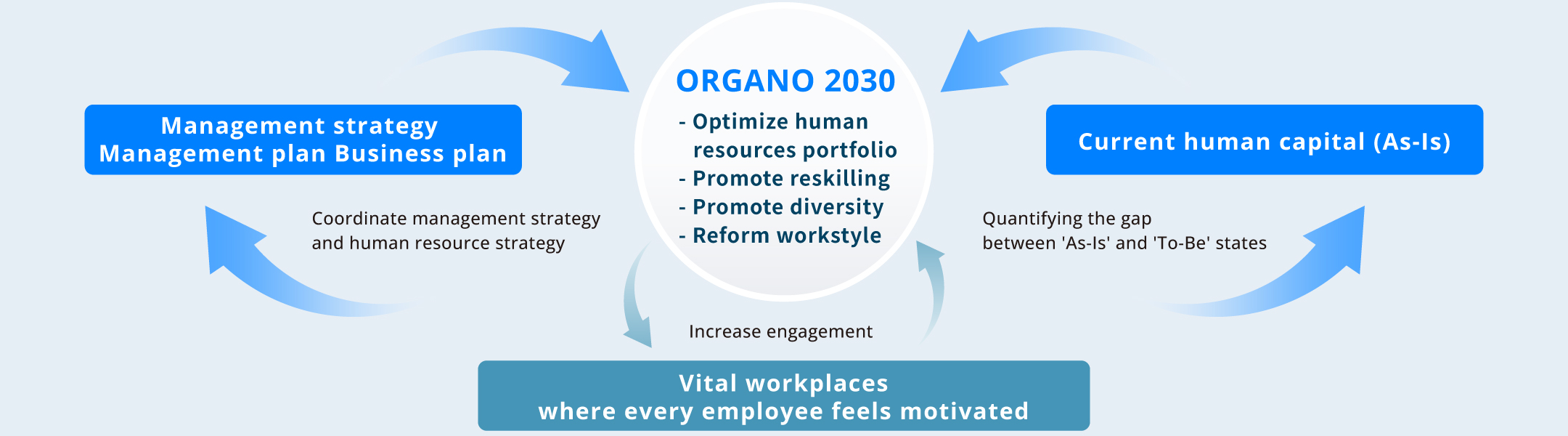
The Organo Group’s human resource strategy embodies its management philosophy of contributing to society through water, and it forms the foundation for achieving Medium- to Long-Term Management Plan ORGANO 2030. The Group is promoting strategic human resource development and placement from both a forecast perspective of predicting future business environments and necessary skills, and a backcasting-based perspective of identifying challenges by working backward from the state it envisions.
In addition, the Group’s competitiveness lies in its personnel, who have the skills, knowledge, and experience accumulated in various industrial fields with a focus on water treatment, as well as the Group’s organizational capabilities, which makes the most of these skills. To that end, identifying both the quality and quantity of human capital is essential for the Group’s sustainable growth. We are therefore developing a skill map as a framework to define the skill sets required for business growth and to link individual employee development with business performance. Our employees understand that their growth is directly linked with creating corporate value, and by taking on challenges to enhance their skills, they are strengthening the competitiveness of the entire organization.
As the Group globalizes its operations, it is essential to understand diverse values. We place importance on fostering the ability of our employees to create and deliver value while respecting different cultures and perspectives. By providing flexible workstyles and establishing a support system based on individual growth targets, we are enhancing employee engagement and building an environment to align individual and corporate growth.
Overall Vision for Achieving ORGANO 2030

Desired Talent and Talent to Develop
The source of our Group’s growth is our water treatment technologies that contribute to addressing social challenges and the human resources that support this. Based on our corporate philosophy, we look for talent who not only have technical skills but also a strong sense of ethics and the ability to collaborate. Within our Group, which emphasizes working as an organization, observing social norms, embracing diversity, and developing mutual understanding are fundamental requirements for our personnel. In the workplace, employees will be required to think and make decisions independently even if still inexperienced. Therefore, it is important to constantly learn and strive for self-improvement. The people who thrive in the Company are characterized by their ability to understand the essence of issues from diverse perspectives, approach challenges flexibly and logically, and act with an awareness of optimizing the organization as a whole.
Promotion of Human Resource Development
Basic concept
Under our long-term management vision, we are undertaking various measures to develop human resources who can help us expand our business through high value-added separation and purification as well as analysis and manufacturing technologies, and by providing products and services that promote the creation of value and which resolve the challenges that confront industry and society. We are also cultivating people who proactively contribute to a better tomorrow and who will improve upon the way things were done yesterday.
In addition to offering conventional assigned rank-specific training, we are transitioning to a system of elective training, in which each employee performs a self-assessment to find the areas in which they may be lacking and selects from a menu of training courses that they can take to improve themselves. The Group has established a target of increasing annual per-employee training expenses to ¥100,000 (about double the current amount) by 2030 as a material issue. While we still have room for improvement with actual per-employee expenses at ¥82,753 in FY2024, we provide employees with a wide range of learning opportunities.
Moreover, human resource rotation and global personnel exchange are effective ways to promote career development and reskilling. Additionally, attempts to strengthen psychological safety, such as through the introduction of one-on-one meetings, are essential in human resource development. We believe that these initiatives will lead to an increase in digitally-capable talent and autonomous employees, and these personnel will transform the way we work.
Skill development support
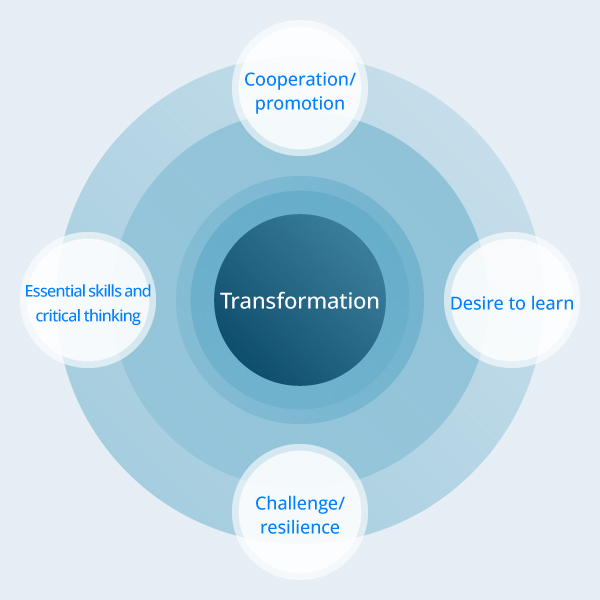
To foster a culture of taking on challenges, we introduced a business improvement award system in FY2023. Visualizing the results increases motivation to take on new challenges. To support skill development, we have expanded our qualification acquisition support system, established a career consultation desk, and introduced elective training, thereby creating an environment that encourages learning and taking on new challenges. Furthermore, by strengthening trust between supervisors and subordinates through one-on-one meetings and diversifying experiences through personnel rotation, we are promoting on the acceptance of challenges and transformations based on knowledge and experience. These initiatives are realizing both employee growth and organizational revitalization.
Programs and initiatives
| Rank-specific training | New employee training | During the first half of roughly six months of training, employees acquire general knowledge as working professionals and regarding Organo’s technologies, and then in the second half they put into practice the skills and knowledge gained. |
|---|---|---|
| DX training | To promote DX, employees are trained to utilize digital technology for business. | |
| Engineering Seminar Basic Course(ESB) | The ESB course involves technology field-specific training concerning Organo’s basic technologies. Participants are able to equip themselves for future career opportunities by gaining extensive knowledge on technologies that are not directly related to their work. | |
| Career training | Participants cultivate the ability to independently grow by learning to take a proactive approach to career development. | |
| Management training | In 2021, we divided management courses into “department head positions,” “expert positions,” and “supervisory positions” to clarify the role of managers. Participants gain role-based management skills. | |
| Elective training | Objective/skill-based training | Employees assess and identify the areas in which they work and select from a menu of training courses that they can take to improve themselves. |
| Self-development | Qualification acquisition support system | To support employees who learn autonomously, the Company subsidizes a portion of the cost employees incur when acquiring one of approximately 300 different formal qualifications. This encompasses target qualifications across a wide range of subject areas such as linguistics and IT, with technical certifications that include professional engineer, assistant professional engineer, and pollution control manager. |
| Organo university (correspondence course subsidy system) | Organo University provides the opportunity to study by featuring 181 correspondence courses across 10 fields of study including technology and sales courses necessary for business, as well as management skills required at different levels of the corporate hierarchy. |
| Rank-specific training | New employee training | During the first half of roughly six months of training, employees acquire general knowledge as working professionals and regarding Organo’s technologies, and then in the second half they put into practice the skills and knowledge gained. |
|---|---|---|
| DX training | To promote DX, employees are trained to utilize digital technology for business. | |
| Engineering SeminarBasic Course(ESB) | The ESB course involves technology field-specific training concerning Organo’s basic technologies. Participants are able to equip themselves for future career opportunities by gaining extensive knowledge on technologies that are not directly related to their work. | |
| Career training | Participants cultivate the ability to independently grow by learning to take a proactive approach to career development. | |
| Management training | In 2021, we divided management courses into “department head positions,” “expert positions,” and “supervisory positions” to clarify the role of managers. Participants gain role-based management skills. | |
Elective training@@@ | Objective/skill-based training | Employees assess and identify the areas in which they work and select from a menu of training courses that they can take to improve themselves. |
| Self- development | Qualification acquisition support system | To support employees who learn autonomously, the Company subsidizes a portion of the cost employees incur when acquiring one of approximately 300 different formal qualifications. This encompasses target qualifications across a wide range of subject areas such as linguistics and IT, with technical certifications that include professional engineer, assistant professional engineer, and pollution control manager. |
| Organo university (correspondence course subsidy system) | Organo University provides the opportunity to study by featuring 181 correspondence courses across 10 fields of study including technology and sales courses necessary for business, as well as management skills required at different levels of the corporate hierarchy. |
Initiatives to Enhance Engagement
Our Group places importance on creating an environment in which each employee can understand the direction of the organization and act autonomously to help realize our management philosophy and long-term management vision. At the heart of this is improving employee engagement. Engagement is not simply a measure of satisfaction, but an indicator of employees’ psychological connection to the Company and their willingness to contribute.
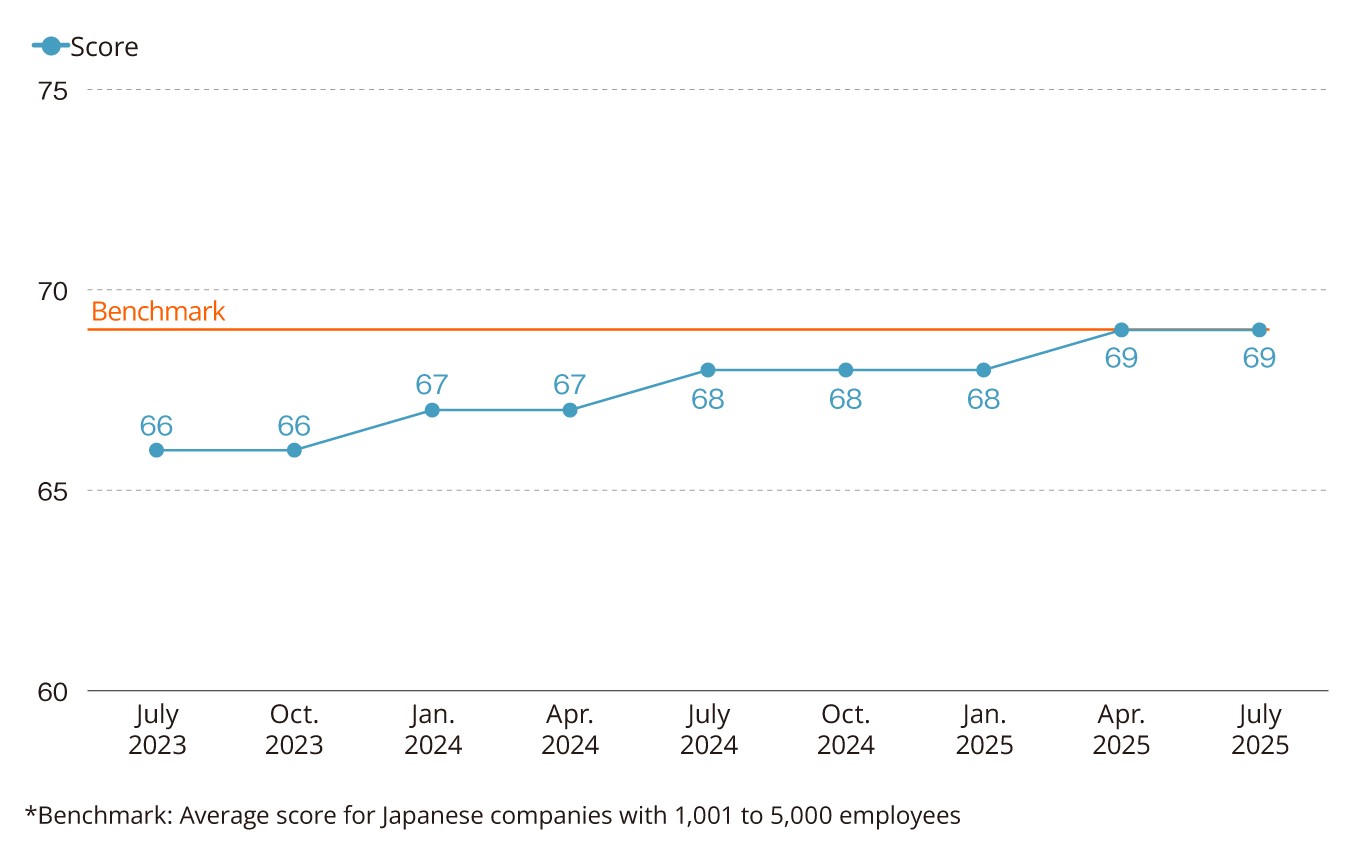
It is also an important element that significantly impacts work efficiency, performance, and employee retention. We continually conduct engagement surveys within the Group once every three months—led mainly by management—with the aim of increasing the sense of unity in the organization. These surveys serve as an important tool in quantitatively identifying employees’ voices while visualizing issues within the organization. The survey score has improved steadily, rising from 66 in July 2023 to the present score of 69. This shows that initiatives to improve engagement are taking hold across the organization.
The survey results show high ratings in areas such as support and interpersonal relationships, indicating that collaborative structures and trust within the workplace are recognized as strengths. Meanwhile, there are still issues in terms of providing career opportunities and creating a culture of taking on challenges, and we are strengthening human resource measures to achieve improvement. Specifically, we are striving to create opportunities for employees to experience self-growth, such as by introducing a performance improvement award system, strengthening job rotation, and implementing one-on-one meetings with management. In addition, to create a culture that encourages taking on challenges, we have launched a business creation talent development program, and are creating an environment where employees can proactively submit new ideas and contribute to improving operations and creating new businesses. Furthermore, initiatives to improve engagement are being driven by each department proactively, and they are working to confront challenges within their teams. We recognize engagement as a key indicator of human capital and will continue to build an organization based on employee feedback, with the aim of enhancing corporate value by realizing a rewarding workplace environment.
Employee engagement score history
Human Resource Strategy KPIs
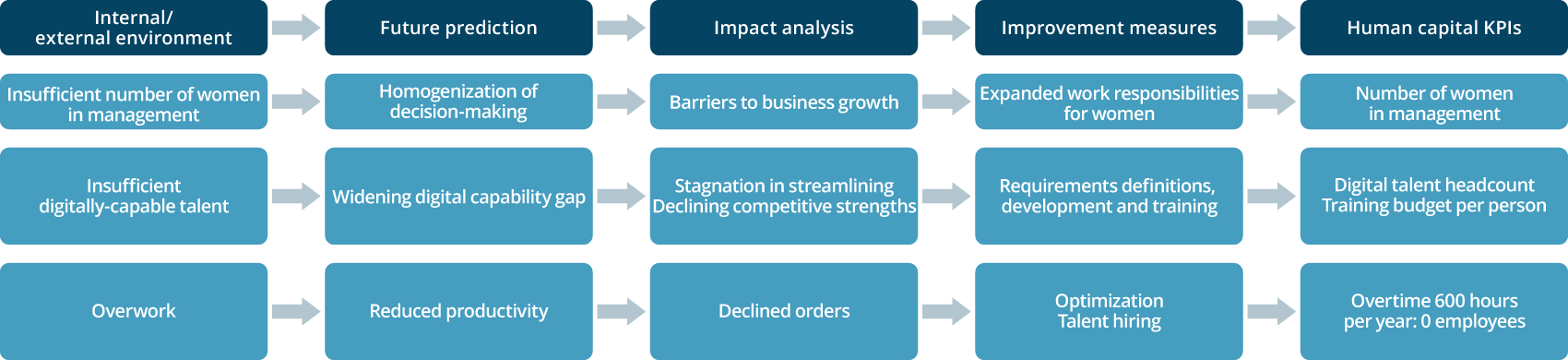
We aim to create a workplace where diverse human resources can play an active and rewarding role, and to that end, we are working on the following material issues.
1. To ensure diversity in terms of standpoint and approach in decision-making processes, we aim to increase the number of female managers to 50.2. We believe that employees find it rewarding when they are able to improve and demonstrate their diverse range of capabilities, and we will work to cultivate human resources and enhance our systems by setting training expenses per employee of ¥100,000.3. We aim to create a rewarding work environment where employees are mentally and physically healthy, and where no employees work more than the annual legal limit for overtime hours.
Related Links