






















Risk ManagementRisk Management
Risk Management Process
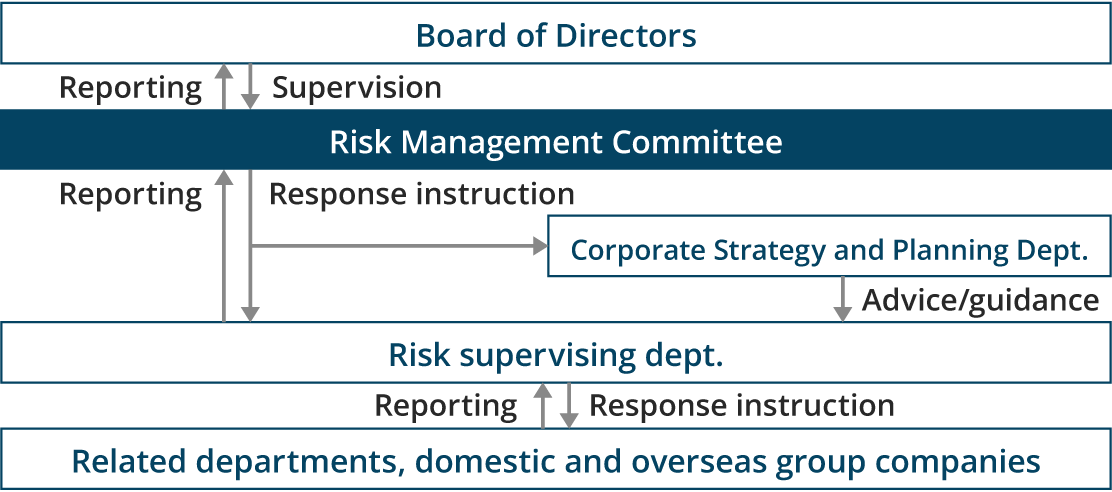
To ensure more appropriate management of major risks, we introduced the Risk Management Committee and established a system to promote risk management with the committee playing a central role.
This committee consists of Executive Directors, Executive Officers with titles, and other members who are selected from the general manager in charge of the primary risk supervising department and from presidents of subsidiaries.
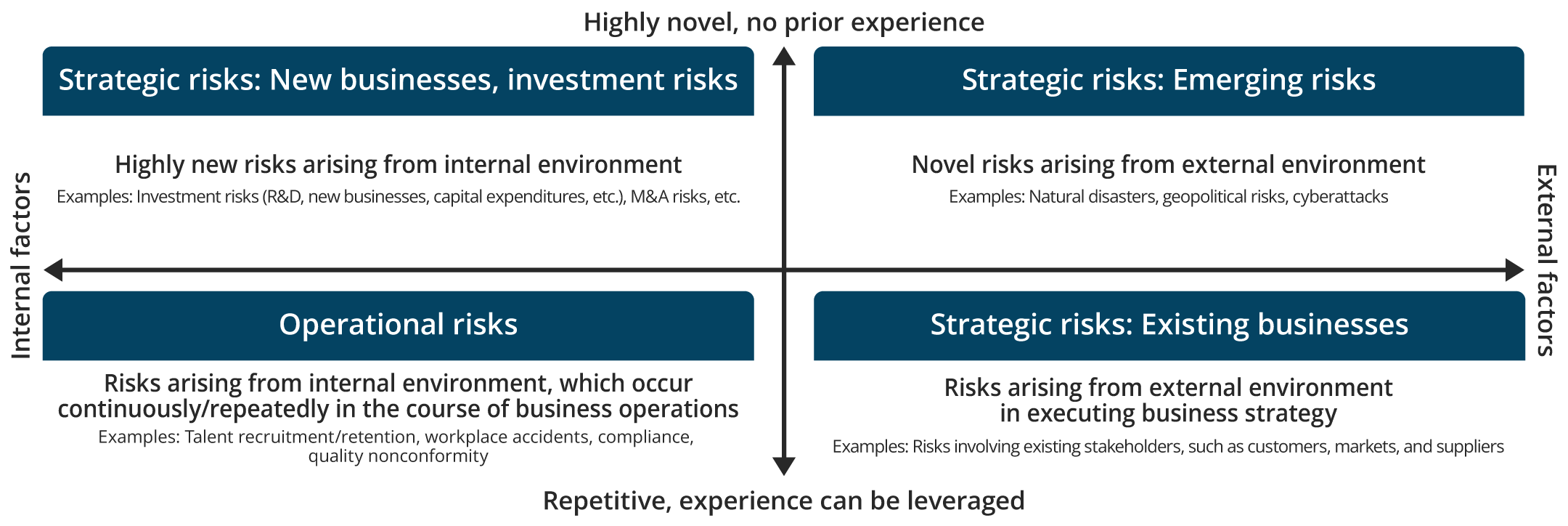
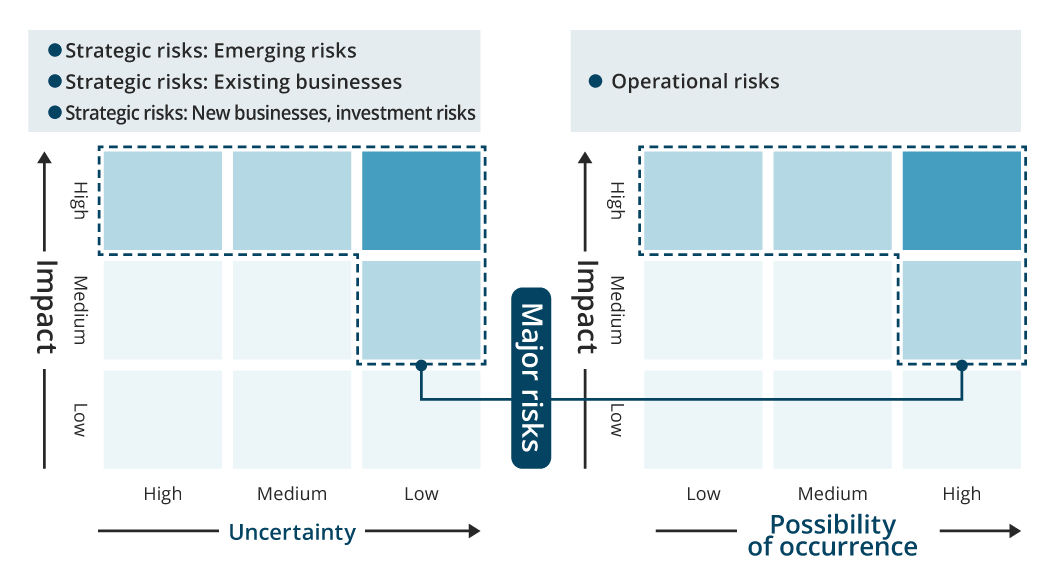
Within the Group, the direction for risk countermeasures varies greatly depending on the risk, and therefore, risks are divided into four quadrants based on risk origin (internal and external factors) and experience (highly novel and recurring). Every year, each department and group company identifies risks, and strategic risks are evaluated based on level of impact and uncertainty while operational risks are evaluated based on level of impact and possibility of occurrence. The Risk Management Committee extracts risks that have been evaluated above a certain level, integrates and evaluates them, and then extracts major risk candidates and selects a supervising department or division in charge of dealing with each major risk. Extracted major risks and their supervising department or division in charge are discussed and determined by the Board of Directors.
Risk Management Committee
Four Risk Quadrants
The department in charge of handling risk response formulates a risk management plan, which is then approved by the Risk Management Committee. The management plan decided upon is then executed led by the supervising department, and the status is monitored by the Risk Management Committee. The Risk Management Committee reports the progress status of the risk management plan to the Board of Directors, who supervises the progress status of the risk response.
Moreover, the Internal Auditing Office performs an internal audit of the operational status of the risk management process from an independent viewpoint to increase the effectiveness of risk management.
Risk Assessment Diagram

Major Risks of the Organo Group
- Risk category
- (1)
Strategic risks in emerging risks
- Risk category
- (2)
Strategic risks in existing businesses - (3)
Strategic risks in new businesses and investment risks
- Risk category
- (4)
Operational risks
- Item
- Production and delivery capacity
- Securing human resources
- Product and service quality, product safety, non-compliance with contract terms
- Safety
- Compliance and internal control
- Intellectual property rights
- Environmental issues
- Description
- Risk of insufficient production and delivery capacity leading to missed growth opportunities, loss of market share due to customers switching to competitors, and loss of trust from existing customers
- Risk of long-term decline in competitiveness of the Group in the event of a failure to secure and train human resources
- Risk of serious quality issues with products and services
- Risk of increased costs due to changes in specifications after receiving orders or changes in cost of materials and construction and risk of compensation for damages due to specifications or delivery date not being met
- Risk of serious occupational accidents and injuries during construction and production activities
- Risk of detection of legal or compliance violations or significant deficiencies in internal controls related to financial reporting
- Risk of infringement of the Group’s intellectual property rights or unintentional infringement of intellectual property rights of other companies by the Group
- Risk of increased costs due to tighter environmental regulations, risk of environmental pollution due to restrictions on business activities or unforeseen circumstances, risk of regulatory violations
- Response
- Expand delivery system by increasing global workforce and improving efficiency through automated design work and outsourcing
- Invest in boosting the supply capacity of ion exchange resin
- Promote education for digital human resource development in addition to rank- and function-specific training
- Promote the creation of a workplace where diverse human resources can play an active and rewarding role
- Upgrade quality management system, strengthen supplier quality surveys, improve production processes, prevent recurrence through horizontal deployment of nonconformity information, and upgrade various types of insurance
- Conduct risk assessment specific to long-term contracts prior to receiving orders and strengthen budget performance management for projects after receiving orders
- Enhance hazard awareness through “kiken yochi” hazard prediction training of new employees and younger staff
- Foster safety awareness by educating supervisors on relevant laws and regulations
- Enhance on-site safety confirmation by strengthening patrols and consistently implementing pre-work risk assessments
- Implement safety audits by external experts
- Implement safety training, report the status of occupational accidents and other incidents and share information on improvement measures via safety education and the intranet
- Distribute messages from the Representative Director and President and enhance employee education
- Work to disseminate Organo Group Company Code of Conduct
- Direct the Compliance Committee to establish a compliance system and education plan
- Work to develop and disseminate a whistleblowing system in Japan and overseas
- Strengthen both hardware and software systems such as by restricting connection of external devices and updating the internal information management system
- Protect intellectual property through proactive filing of patent applications in Japan and overseas, and regularly monitor the status of applications filed by other companies, including those overseas
- Conduct risk assessment and enhance education
- Ensure proper equipment delivery and management and comprehensive monitoring
Business Continuity Plan (BCP)
The Company has formulated the Crisis Management Basic Regulations and the following Basic Policy on Crisis Management to set up, operate, and promote its crisis management system. In addition to formulating a BCP to minimize damage and ensure business continuity in the event of a disaster, such as an earthquake or large-scale accident, we are working to improve the effectiveness of our BCP by preparing for emergency situations and implementing education and training.
Basic Policy on Crisis Management
- (1) Prioritizing the safety of human life
Human life comes first, and our top priority is to confirm the safety and well-being of officers, employees, and their families, as well as the employees of our partner companies.
- (2) Rapid restoration and continuation of the Company’s and its customers’ operations
As a partner company, we will do our utmost to achieve the rapid restoration and business continuity of our company as well as our customers’ facilities and factories.
- (3) Ensuring the protection of critical assets and the establishment of a rapid and accurate information communication system
We will work to protect information and other critical assets, and rapidly and accurately collect, report, and share information in the event of a crisis.
- (4) Contribute to the local community
We will contribute to the local community by ensuring the safety of surrounding areas, preventing secondary disasters, and supporting the recovery of affected areas.
- (5) Continuous improvement through business continuity management (BCM)
We will make continuous improvements to the crisis management system and measures through BCM in preparation for various risks that could disrupt safety and business continuity, such as disasters and cyberattacks.
Initiatives to Prepare for Large-Scale Disasters
The crisis management headquarters conducted exercises based on detailed scenario analyses assuming specific situations that could have a significant impact on the Company. These exercises served as training to ensure readiness in the event of a disaster and to verify the effectiveness of the formulated BCP. Through the experience of these exercises, we were able to identify specific issues, such as improving the accuracy of the safety confirmation and emergency communication system, enabling prompt action and continued appropriate operation going forward.
Related Links