






















Climate Change ActionClimate Change Action
Information Disclosure Based on TCFD Recommendations
Climate change action
Climate change is a serious issue that must be tackled on a global level. At the same time, it is also a serious issue with an impact on the business activities of the Organo Group.
In accordance with the climate-related disclosures framework developed by the Task Force on Climate-Related Financial Disclosures (TCFD), we are analyzing risks and opportunities climate change would have on the business of the Organo Group, based on two scenarios: if climate change worsens, and if a decarbonized society can be realized. We will take the risks and opportunities that were discovered during this analysis and include them in future management strategy and risk management efforts, provide appropriate disclosure of our progress in these areas, and aim to grow our business ever further while at the same time proactively working toward achieving the shared global goal of carbon neutrality.
Governance
Sustainability Committee
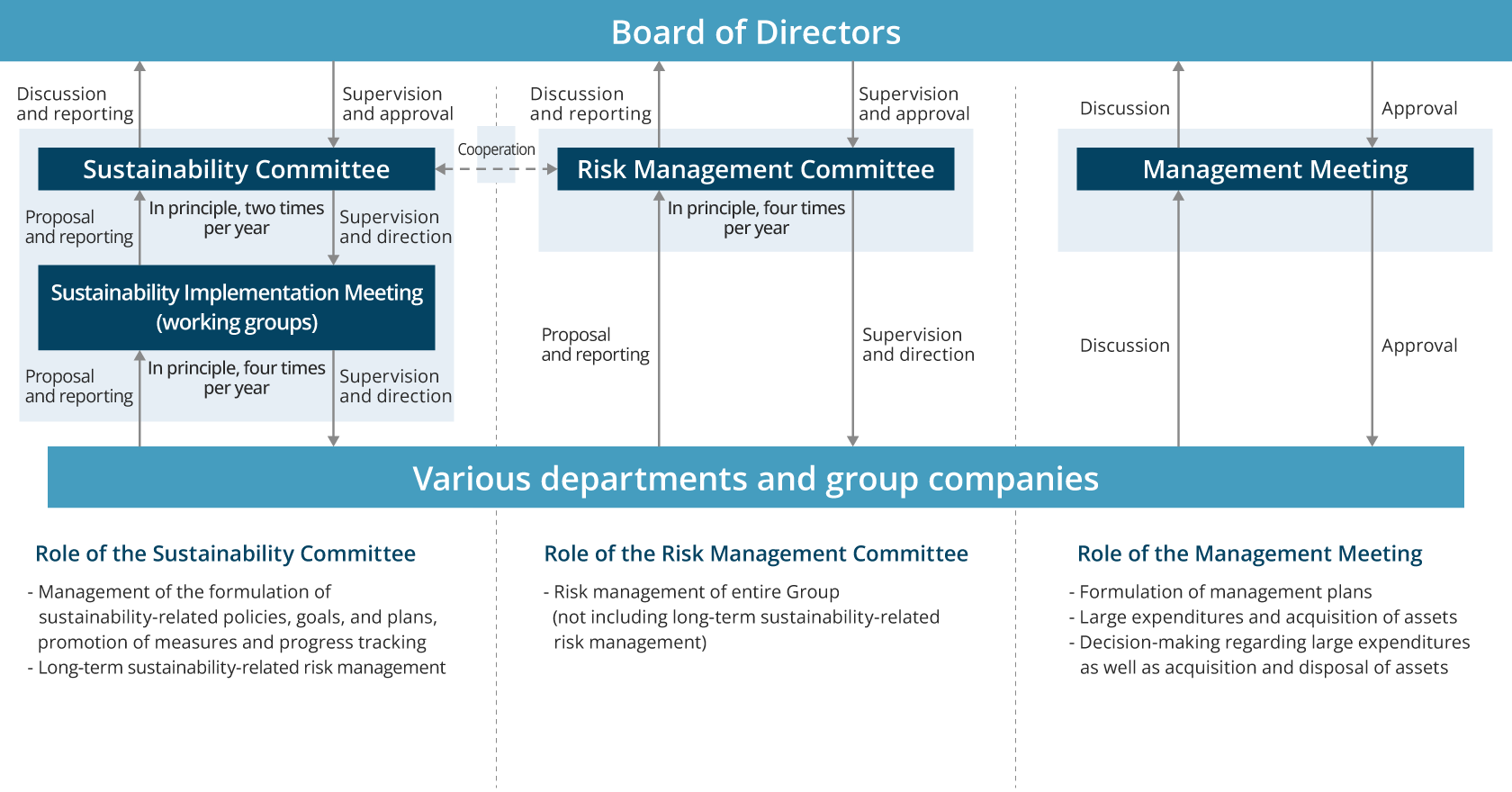
Organo has established the Sustainability Committee as an organization responsible for the sustainability management of the Organo Group, with the representative director and president acting as head of the committee. This committee establishes basic policies, plans, and targets related to sustainability, including climate-related policies, and also monitors the status and progress of measures we have taken.
The committee met five times during fiscal year 2025 to discuss topics such as emission reduction target values and material issues including KPIs to achieve, and also to confirm sustainability measure progress and KPI results.
Important basic policies, plans, and targets discussed by the committee are brought up to the Board of Directors for discussion and final approval. Major sustainability-related measures and KPI progress are also reported as needed to the Board of Directors. The committee reported to the Board of Directors two times during fiscal year 2025.
Sustainability implementation meetings
Organo has established a Sustainability Implementation Meeting as a sub-organization under the Sustainability Committee, to advance specific measures based on basic policies and plans. The Council forms working groups to address sustainability issues as they arise, with members selected from related departments and group companies to drive initiatives toward resolution. The Sustainability Implementation Council currently has five working groups responsible for climate change action and other initiatives — including GHG emissions calculation and reduction measures, SDG-related initiatives, CSR procurement, and TCFD recommendations response. Progress on these measures is reported to the Sustainability Committee as appropriate.
Risk Management Committee
Risk management related to sustainability is included in the overall risk management efforts of the Organo Group (including sustainability). We analyze and assess risks discovered from within the Organo Group, identify major risks for the group, and determine supervising departments for each type of risk, with the Risk Management Committee serving as the hub of this activity. These supervising departments take the lead in responding to major risks that have been identified.
Sustainability-related governance structure

Strategy
The Organo Group has analyzed scenarios based on the 1.5°C Scenario (for more information, refer to "WEO2023 NZE," International Energy Agency [IEA]) and 4°C Scenario (for more information, refer to RCP8.5, Intergovernmental Panel on Climate Change [IPCC]). We identified risks and opportunities from each scenario, assessed the financial impact of each item, and then conducted a quantitative estimate of the financial impact of important risks and opportunities for which specific impacts could be estimated at the current time. Our policy for risks is to assess the impact on Organo's profit for the relevant fiscal year. For opportunities, our policy is to carefully examine specific impacts on Organo's performance through investigating future business plans. Certain group companies were excluded from the analysis until fiscal year 2024. However, all group companies included in consolidated financial statements are now included in the scenario analysis as of fiscal year 2025.
1.5°C Scenario risks and opportunities
°C risks
- Category
- Political measures
- Market
trends - Technology
- Reputation
- Scenario trends
- Introduction of carbon tax and GHG emissions regulations
- Market expansion due to promotion of EVs and introduction of smart technologies into cities
- Changes in power source configurations
(introduction of renewable energy and new fuels) - Increased social demand for the reuse and effective utilization of waste
- Increased demand for products and services related to reducing environmental impact, preventing/mitigating disasters, and conserving energy or using renewable energy
- Major items
- Increased procurement costs or internal manufacturing equipment expenses due to carbon tax burden on Organo or suppliers
- Increased demand for functional materials due to growing need for EV-related products and semiconductors, leading to rise in raw material prices
- Increased costs associated with switching to renewable energy and alternative electricity providers
- Reduced sales of products and services of low energy efficiency
- Increased waste disposal costs
- Damaged reputation due to failure to reduce GHG emissions, reducing usage/sales of products and services
- Timing
- Medium/
long - Medium/
long - Medium
- Medium
- Medium/
long - Medium/
long
- Countermeasure
- Reduce our own direct GHG emissions through means such as introducing renewable energy
- Set appropriate prices based on economic rationality
- Promote energy conservation
- Continue to optimize production processes
- Enhance development of energy conservation products and services
- Reduce waste
- Further reduce GHG emissions
- Strengthen disclosure of GHG emission information related to Organo products and services, as well as enhancing responsiveness to client questionnaires and other information requests
°C opportunities
- Category
- Political measures
- Market
trends - Technology
- Reputation
- Scenario trends
- Introduction of carbon tax and GHG emissions regulations
- Promotion of CCUS* use to reduce CO₂ emissions and promote recycling
- Strengthening of water consumption regulations
- Market expansion due to promotion of EVs and introduction of smart technologies into cities
- Changes in power source configurations
(introduction of renewable energy and new fuels) - Increased social demand for the reuse and effective utilization of waste
- Increased demand for products and services related to reducing environmental impact, preventing/mitigating disasters, and conserving energy or using renewable energy
- Major items
- Increased sales due to greater demand for low-carbon technologies/products and services
- Increased sales of related products and services due to greater need for CCUS-related technologies
- Increased sales of equipment and chemicals helping to recover wastewater and conserve water
- Increased sales of related products and services due to greater EV-related needs
- Increased sales of Organo's related products and services driven by changes in the power generation mix toward renewable energy and alternative fuels
- Increased sales due to expanded use of resource recycling technologies
- Increased inquiries from new/existing customers as we promote decarbonization and proactively promote the disclosure of related information for business partners
- Timing
- Medium/
long - Long
- Medium/
long - Medium/
long - Medium
- Medium/
long - Medium/
long
- Countermeasure
- Expand lineup of products and services that contribute toward reducing customer GHGs, water consumption, and waste
- Enhance and expand development of next-generation separation and purification technologies
- Expand lineup of products and services that contribute toward reducing customer GHGs, water consumption, and waste
- Expand lineup of products and services that contribute toward reducing customer GHGs, water consumption, and waste
- Expand lineup of products and services that contribute toward reducing customer GHGs, water consumption, and waste
- Reduce GHG emissions
- Strengthen disclosure of GHG emission information related to Organo products and services, as well as enhancing responsiveness to client questionnaires and other information requests
4°C Scenario risks and opportunities
°C risks
°C opportunities
- Category
- Physical
(acute) - Physical
(chronic) - Physical
(acute) - Physical
(chronic)
- Scenario trends
- Increasingly severe natural disasters
- Chronic climate change
(rising sea levels) - Chronic climate change
(rising average temperature) - Increasingly severe natural disasters
- Chronic climate change
(rising average temperature)
- Major items
- Risk of production delays/stoppages due to soaring supply costs or difficulty obtaining raw materials, due to supply chain fragmentation following abnormal weather
- Risk of uninsured goods in process or inventory being disposed of due to flood damage at Southeast Asia locations
- Reinvestment in mechanical equipment due to flood damage at Southeast Asia locations
- Risk of uninsured goods in process or inventory being disposed of, and risk of damage to mechanical equipment, due to flooding at Southeast Asia locations
- Investment in flood control measures or reinvestment related to factory relocation in the event of increased risk at levels at Southeast Asian locations*
- Longer breaks for employees working outdoors due to higher temperatures, resulting in lower productivity or higher labor costs
- Increased energy costs due to extended or intense use of A/C
- Stabilized supply or reduced costs as suppliers of major raw materials are diversified or overseas locations switch to local procurement
- Increased demand for cooling technology and sterilization/antibacterial technology, driving sales growth for disinfectants and cooling water-related products, as temperatures rise
- Timing
- Medium/
long - Medium/
long - Medium/
long - Long
- Long
- Medium/
long - Medium/
long - Medium/
long - Medium/
long
- Countermeasure
- Strengthen supply chain and diversify suppliers
- Prepare BCP based on regular surveys of flooding risks, etc. at Organo locations
- Continue to optimize insurance, including for water damage
- Develop processes to accelerate site construction
- Implement flexible working hours
- Introduce energy-efficient A/C equipment
- Diversify suppliers and enhance local procurement
- Enhance development of coolant chemicals and expand sales
Major financial impacts for fiscal year 2030 under the 1.5°C Scenario
- Following the introduction of carbon taxes and GHG emissions regulations, we anticipate a cost increase of slightly over ¥500 million on a pre-tax profit basis in FY2030—driven by our own carbon tax burden, as well as increased procurement costs and manufacturing equipment expenses passed through from suppliers and other partners affected by the same tax. We also anticipate an additional cost increase of slightly under ¥300 million in FY2030, resulting from higher electricity rates and waste disposal costs due to changes in the energy mix (renewables and new fuels).
- Under the 1.5°C scenario, demand for semiconductors is expected to grow with EV adoption and the spread of smart technologies across society. We see this as a major opportunity for business growth in products and services such as water recovery plants and chemicals.
Major financial impact in FY2050 under the 4°C scenario
- Under the 4°C scenario, productivity would decline for Organo employees working outdoors on engineering projects, and we anticipate a group-wide outsourced labor cost increase of slightly under ¥900 million in FY2050.
- At our Southeast Asia locations, we have continued to take appropriate measures from a business continuity planning (BCP) perspective—such as arranging property and casualty insurance covering water damage to mechanical equipment, inventory, and other assets. Based on our current assessment, the financial impact of increasingly severe natural disasters would be limited.
Transition plan
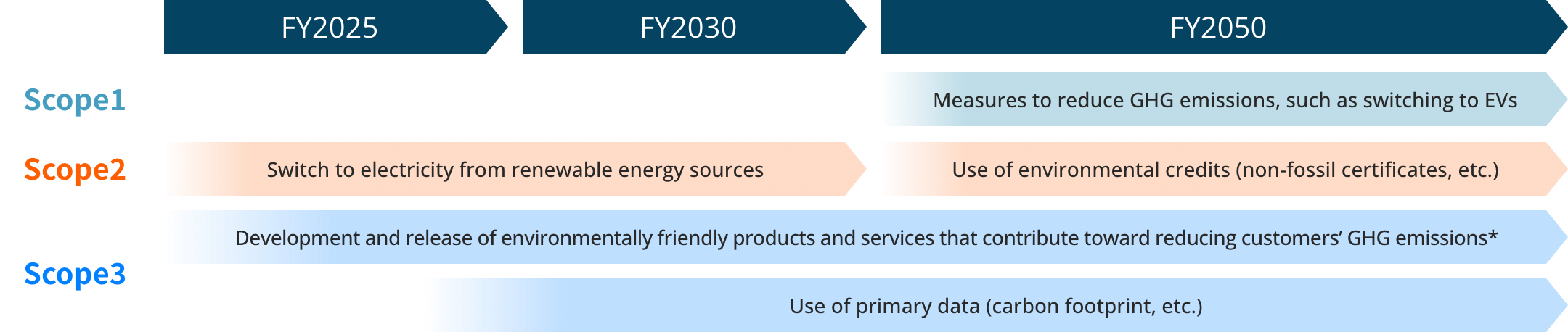
For Scope 2, we aim to achieve our FY2030 target by switching to renewable electricity. For emissions from rental properties and other locations where switching to renewable electricity would be difficult, we will use environmental credits such as non-fossil certificates to achieve our FY2050 carbon neutrality target. We continue to evaluate measures to reduce Scope 1 emissions, such as transitioning our vehicle fleet to EVs.
Category I (purchased goods and services) and Category II (use of sold products) account for the majority of the Organo Group's Scope 3 GHG emissions, and we will advance measures to reduce both. For Category I, we will work with suppliers on emission reduction initiatives — encouraging them to reduce their own emissions and using more detailed primary data (including carbon footprints) in our GHG calculations to reflect upstream reduction efforts. For Category II, we will improve the precision of our GHG emissions calculations so reduction efforts are properly reflected, and aim to reduce emissions by developing and launching environmentally friendly products and services that help our customers reduce their GHG emissions. Some of these products and services require a long-term perspective; for projects that contribute to GHG reduction and have strategic significance, we will promote investment by extending the investment evaluation period.
GHG Emissions Reduction Roadmap to 2050
Risk Management
Under the Sustainability Committee's oversight, the Climate-Related Scenario Analysis Working Group—established by the Sustainability Implementation Meeting—conducted a scenario analysis covering domestic and overseas group companies. The working group identified future business risks and opportunities arising from climate change and conducted a quantitative analysis of their financial impact. The Sustainability Committee then analyzed and evaluated these findings based on factors such as materiality, likelihood of occurrence, and time horizon, and quantified the major risks.
Risk management at the Organo Group—including sustainability-related risks—is led by the Risk Management Committee as the central hub, working in collaboration with the Sustainability Committee. The Risk Management Committee leads on major short- and medium-term risks, while the Sustainability Committee leads on major long-term risks (through 2050).
For major climate-related risks identified over the medium to long term, the response direction is first set by the Long-Term Management Plan Promotion Meeting, then incorporated into the medium-term management plan and the fiscal year profit plan. These plans are then finalized by the Board of Directors following deliberation at Management Meetings. The status and progress of medium- to long-term climate risk responses are reported from the Sustainability Implementation Meeting to the Sustainability Committee, and then to the Board of Directors as appropriate.
When responding to these risks and opportunities involves significant expenditures or the acquisition or disposal of assets, such matters are brought to the Management Meeting or the Board of Directors for deliberation, depending on the nature and scale of the amounts involved.
Indicators and Targets
The Organo Group views climate change as a serious challenge requiring global action. We have set targets for reducing GHG emissions to help realize a sustainable society and have been implementing initiatives to achieve these targets.
For Scope 1 and 2 emissions, we have set a target to reduce emissions by 42% by FY2030 compared to those of base year (FY 2021) and to achieve carbon neutrality by FY2050. For Scope 3 emissions, we aim to reduce GHG emissions per gross profit margin by 20% by FY2030 compared to that of the base year (FY2021).
In terms of actual results, Scope 1 and 2 emissions in FY2025 were reduced by 41% compared to the base year. The primary factor behind this reduction was the phased introduction of electricity generated from renewable energy sources. Going forward, we will continue promoting emission reduction initiatives at all our group locations, while also evaluating our progress towards achieving the reduction targets. For Scope 3 in FY2025, the emission per gross profit margin was reduced by 28% compared to that of base year. Following the previous fiscal year, an improvement in business profitability (a higher gross profit margin) was the main reason for the temporary achievement of the FY2030 target. Nevertheless, we will continue implementing our planned Scope 3 reduction measures to ensure that we consistently meet the target by the end of FY2030.
Organo Group GHG emission reduction targets
- Scope 1/2
- Scope3
- FY2030
- 42% reduction (versus FY2021)
- 20% reduction in GHG emissions per gross profit margin
(compared to FY2021)
- FY2050
- Carbon Neutrality
- Engaging in reduction efforts in collaboration with stakeholders to build a decarbonized society
Organo Group GHG emission reduction results*
- Scope 1/2
(Total) - Scope3
(Per gross profit margin)
- FY2021 (base year)
- 10,118 t-CO₂
— - 3,461 t-CO₂
per 100 million yen
—
(Total: 975,663 t-CO₂)
- FY2023
- 6,737 t-CO₂
33% decrease - 3,564 t-CO₂
per 100 million yen
3% increase
(Total: 1,547,710 t-CO₂)
- FY2024
- 6,223 t-CO₂
38% decrease - 2,321 t-CO₂
per 100 million yen
33% decrease
(Total: 1,269,701 t-CO₂)
- FY2025
- 5,970 t-CO₂
41% decrease - 2,477 t-CO₂
per 100 million yen
28% decrease
(Total: 1,611,863 t-CO₂)
In light of this change, we have adjusted the GHG emission figures for previous years based on the current scope of the calculations and recalculated the reduction or increase rates.
Additionally, with regard to Scope 3, we have updated the GHG emissions figures for all financial years to reflect the enhanced accuracy of the collected data.
Organo Group Scope 3 GHG emission results by category*
- Category
- Category 1:
Purchased goods
and services - Category 2:
Capital goods - Category 3:
Fuel and energy
related activities
(not included in Scope 1/2) - Category 4:
Upstream transportation
and distribution - Category 5:
Waste generated in operations - Category 6:
Business travel - Category 7:
Employee commuting - Category 8:
Upstream leased assets - Category 9:
Downstream transportation
and distribution - Category 10:
Processing of sold products - Category 11:
Use of sold products - Category 12:
End-of-life treatment of
sold products - Category 13:
Downstream leased assets - Category 14:
Franchises - Category 15:
Investments
- Base year
FY2021 (t-CO₂) - 320,645
- 8,831
- 2,752
- 16,500
- 3,021
- 303
- 583
- 53
- 553
- Not applicable
- 571,487
- 5,798
- 45,137
- Not applicable
- Not applicable
- FY2023 (t-CO₂)
- 428,934
- 4,989
- 1,446
- 14,133
- 3,505
- 313
- 604
- 63
- 496
- 1,036,558
- 5,427
- 51,241
- FY2024 (t-CO₂)
- 340,344
- 7,161
- 1,279
- 12,165
- 3,981
- 334
- 644
- 57
- 417
- 826,017
- 6,406
- 70,897
- FY2025 (t-CO₂)
- 372,511
- 9,255
- 1,269
- 20,572
- 3,873
- 351
- 676
- 33
- 486
- 1,118,059
- 9,435
- 75,343
In light of this change, we have adjusted the GHG emission figures for previous years based on the current scope of the calculations. Additionally, with regard to Scope 3, we have updated the GHG emissions figures for all financial years to reflect the enhanced accuracy of the collected data.
CDP
The Organo Group discloses information related to climate change and water security through CDP. CDP is an international environment-related nonprofit organization committed to ensuring an economy that is both healthy and prosperous for people and the planet. It requests companies and local governments to disclose information related to the environment. CDP sends companies Q&A forms covering topics such as environment-related management systems, and then analyzes the responses and ranks the initiatives of each company on an eight-tier scale from A to D-. The Organo Group received a "B" score for climate change in 2025, which is the third highest score possible. This score is awarded to companies who are "aware of their own environmental risks and the impacts of these risks, and are acting on these risks and impacts" and who are "managing risks and impacts of environmental issues, and have formulated and implemented associated strategies." Organo also received an "A" score for water security the same year, which is the highest score possible. Only the top 4% of companies evaluated by CDP receive such a score. The Organo Group will continue engaging in initiatives concerning the issues of decarbonization and water conservation, both of which are included in the CDP Q&A form, and will continue to disclose information.
Organo Group CDP scores
| Climate Change | Water Security | |
| FY2022 | C | Unanswered |
| FY2023 | B | Unanswered |
| FY2024 | B | B |
| FY2025 | B | A |
| Climate Change | Water Security | |
| FY2022 | C | Unanswered |
| FY2023 | B | Unanswered |
| FY2024 | B | B |
| FY2025 | B | A |
Climate Change: B
Water Security: A
Climate Change: B
Water Security: A
Related Links