






















Our Approach
- Respect shareholder rights and ensure equality.
- Consider the interests of a wide range of stakeholders, including shareholders, investors, consumers, customers, business partners, employees, and local communities, and collaborate appropriately with these stakeholders.
- Disclose corporate information in a timely and appropriate manner to ensure transparency.
- Directors, Audit and Supervisory Board Members, and Executive Officers shall recognize their fiduciary responsibilities and effectively fulfill their required roles and responsibilities.
- Engage in constructive dialog with shareholders.
Organo Group Report (Integrated Report)
Corporate Governance Structure
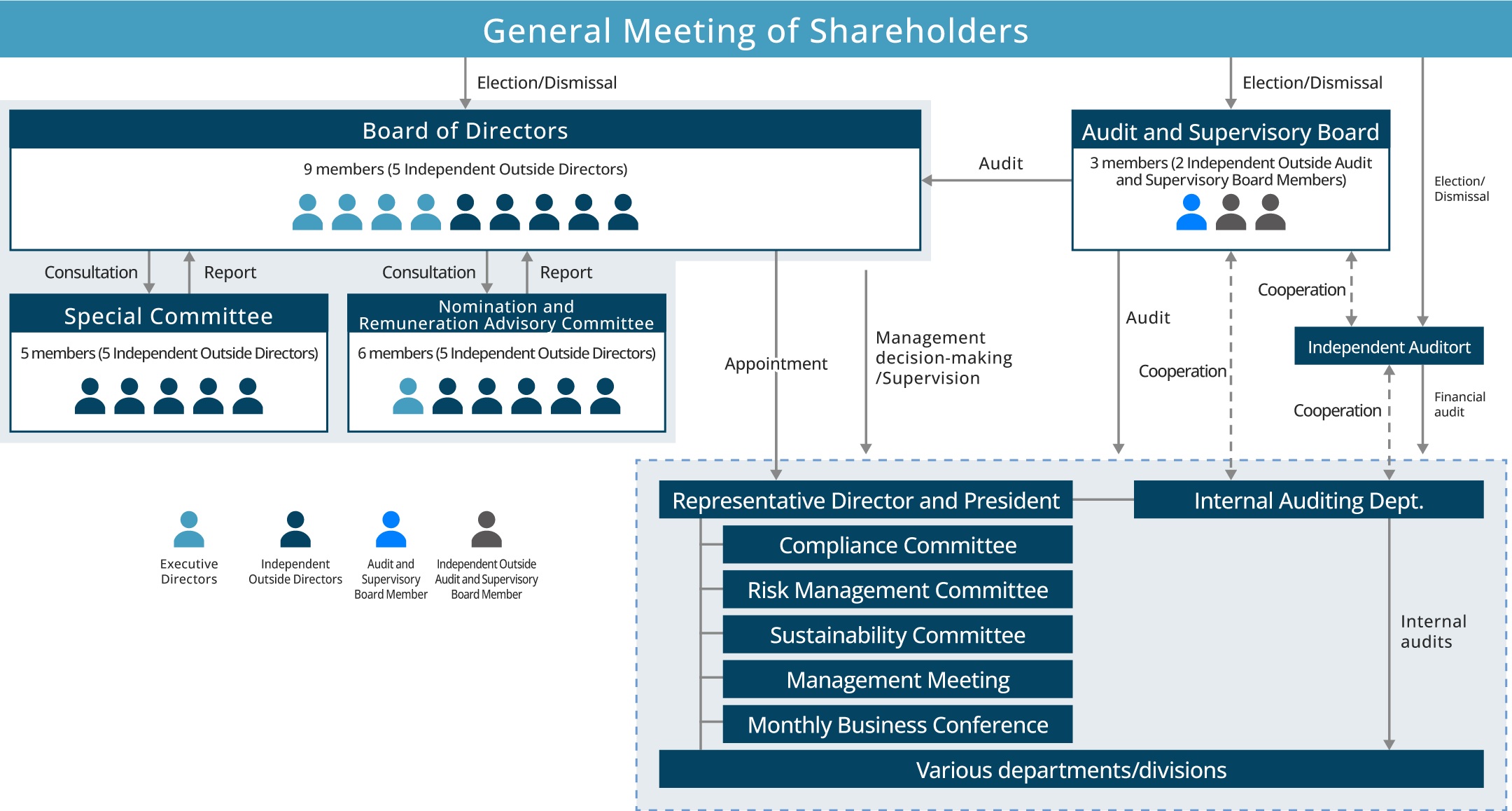
Corporate Governance Structure Diagram

Board of Directors
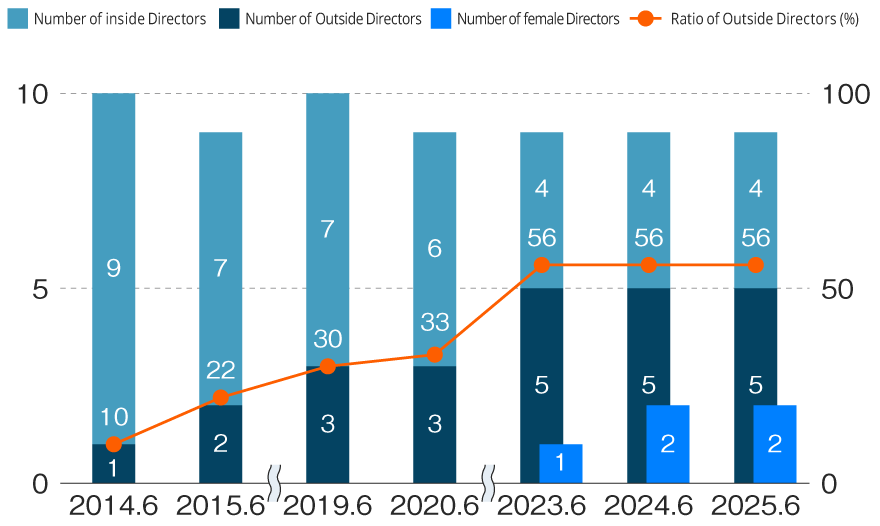
The Board of Directors consists of nine Directors (including five Outside Directors). In principle, it meets at least once a month (a total of 14 meetings during the 81th fiscal period) to make decisions on important business matters and oversee business execution.
By ensuring that Independent Outside Directors make up at least one-third of the Board—currently a majority—we strengthen the Board's oversight of management.
All three Audit and Supervisory Board Members attend Board of Directors meetings, receive reports and business explanations from Directors, and provide their opinions as needed—auditing the business execution of executives including the Representative Director and below.
The Board of Directors is structured at an appropriate size and composition to exercise oversight across all areas of management while ensuring fairness and transparency. We believe diversity on the Board is essential for multifaceted, effective deliberations. Accordingly, we identify the knowledge, experience, and capabilities the Company needs to achieve sustainable growth and maximize long-term corporate value, and appoint Directors who collectively bring these qualities—creating a Board whose strengths are complementary.
Transition of Board of Directors Size and Composition
Audit and Supervisory Board and its members
We have an Audit and Supervisory Board, and it consists of three Audit and Supervisory Board Members (including two Outside Audit and Supervisory Board Members). In principle, it meets once a month (a total of 14 meetings during the 81th fiscal period) to establish the auditing policy for the fiscal year, the division of duties among each member, specific implementation items, and the audit schedule—and audits the execution of duties by Directors. Audit and Supervisory Board Members attend important meetings, including those of the Board of Directors, to audit and verify the decision-making process of Directors. They also report on and discuss audit results at meetings of the Audit and Supervisory Board. Two members have appropriate expertise in finance and accounting, and one has appropriate expertise in legal affairs. We have also established a Secretariat for the Audit and Supervisory Board to support the duties of its members.
Nomination and Remuneration Advisory Committee
The Nomination and Remuneration Advisory Committee has been established as a voluntary advisory body to the Board of Directors. Its purpose is to ensure objectivity and transparency in the processes for nominating officers—including the appointment and dismissal of Directors and Executive Officers—and for determining the remuneration of Directors and other officers, and to ensure that nominations and remuneration amounts are appropriately set. The Committee consists of three or more Directors elected by resolution of the Board, with a majority being Outside Directors to ensure independence. The Committee currently has six members: five Independent Outside Directors and one Inside Director, with an Independent Outside Director serving as Chairperson. It met ten times during the 81th fiscal period.
Special Committee
In April 2022, we established a Special Committee to ensure fair transactions in important dealings with our parent company Tosoh Corporation and its subsidiaries (excluding the Company and its subsidiaries), to monitor and oversee conflicts of interest between the parent company group and minority shareholders, and to appropriately protect minority shareholder interests. The Committee ensures its independence by consisting solely of Independent Outside Directors (five members).
Roles of the Board of Directors and Individual Directors
In FY2024, the Company held repeated discussions at the Nomination and Remuneration Advisory Committee regarding the current roles of its Board of Directors and individual Directors, and redefined those roles in line with recent changes to the state of boards of directors in Japan, following a resolution by the Board of Directors. (Corporate Governance Guidelines Articles 13 to 15)
The discussions confirmed that the Company is a company with an Audit and Supervisory Board adopting a so-called hybrid model that emphasizes the decision-making function of the Board of Directors while also strengthening its supervisory function. While we previously defined the roles of Independent Outside Directors, we first clarified the roles of Directors, and then further defined the position of Independent Outside Directors, as well as the stance and perspectives they should hold. The Company will continue to investigate how the Board of Directors and individual Directors can lead to the enhancement of corporate value.
Redefined Corporate Governance Guidelines (Excerpt)
- Article 13 (Form of Corporate Organ)
- - The Company selects "company with an Audit and Supervisory Board" as its form of corporate organ. The Company positions the Board of Directors as an organ that determines basic policies for the entire Group, makes high-level management decisions, and supervises business execution. It places emphasis on the decision-making function of the Board of Directors for important business execution, and also strives to strengthen the supervisory function of the Board of Directors. The Company has also established a voluntary Nomination and Remuneration Advisory Committee with Outside Directors constituting a majority of its members, which enhances transparency and objectivity in the nomination of Directors and other officers and the determination of their remuneration and other matters. In addition, the Audit and Supervisory Board audits the execution of duties by Directors.
- Article 14 (Roles of the Board of Directors)
- - Entrusted by shareholders, the Board of Directors is responsible for realizing efficient and effective corporate governance, and through this, achieving sustainable growth for the Company and maximizing long-term corporate value.
- - To fulfill the responsibilities outlined in the preceding item, the Board of Directors realizes more sophisticated and in-depth management decisions and makes the best decisions based on discussions from the objective and multifaceted perspectives of Inside and Outside Directors with diverse experience and insight. It also strives to strengthen its supervisory function toward the goal of enhancing corporate value, as well as ensuring compliance and risk management.
- Article 15 (Roles of Individual Directors)
- - Directors participate in the Board of Directors with logical thinking skills based on objective and multifaceted perspectives, and strive to ensure that more sophisticated and in-depth discussions take place.
- - Independent Outside Directors contribute to strengthening the supervisory function of the Board of Directors from a standpoint independent of business execution, toward the goal of enhancing corporate value, as well as ensuring compliance and risk management.
- - Independent Outside Directors have a strong interest in the Group's fields of business and other matters, actively understand the environment surrounding the Group, and make decisions based on their knowledge.
Board Effectiveness Evaluation
Assessment Method for the Board of Directors' Overall Effectiveness
The Company conducts a survey for all Directors and Audit and Supervisory Board Members every year. Based on the results of the survey, the Board of Directors' overall effectiveness is analyzed and assessed and measures to maintain and improve the function of the Board are discussed.
- Scope
- A total of 12 people including nine Directors and three Audit and Supervisory Board Members
- Period
- FY2024 (April 2024 to March 2025)
- Implementation timing
- February–May 2025
- Implementation method
- Survey by third-party organization
Major Initiatives Implemented in FY2024
We implemented the following initiatives based on the evaluation results of FY2023.
Enhanced effectiveness of deliberations by providing explanation in advance
Regarding the Management Meeting and the Risk Management Committee, which are bodies that deliberate on proposals to be submitted to the Board of Directors, the Company provided notices of their meetings to outside officers and shared information with them to encourage them to participate in these meetings. The Company also sent meeting minutes to them after the meetings to provide information before Board of Directors' meetings are convened. In addition to the above, concerning important matters, the Company also considered a system for providing explanations and supplemental information regarding unclear points in information prior to Board of Directors' meetings.
Consideration toward realization of management conscious of cost of capital and stock prices
In preparation for discussions centered on the "cost of capital" at Board of Directors' meetings and other meetings, the Company invited outside experts to provide training designed to help management acquire knowledge and raise awareness. Opportunities for discussion were provided at Board of Directors' meetings to discuss matters related to the next fiscal year's profit plan, including the trends of the Company's cost of capital and market evaluation, comparison with competitors, business portfolio analysis, capital allocation, shareholder returns, and capital policies.
Held discussions on "value creation and provision through utilization of digital technology and data" and "investment in human capital and alignment with management strategy"
At Board of Directors' meetings, initiatives and future plans regarding "promotion of utilization of data" and "initiatives to link human capital with enhancement of corporate value" were reported and opportunities for discussion were provided. These issues will continue to be discussed at Board of Directors' meetings and the initiatives will be further invigorated.
FY2024 Evaluation Assessment and Future Initiatives
The following are the assessment results and future initiatives based on the analysis and assessment of effectiveness conducted in FY2025. The Board of Directors will implement these to further improve its function going forward.
Establishment of internal control systems, including those of overseas subsidiaries, and management and oversight of their operation
As the Group's overseas business development accelerates, in order to strengthen the governance of domestic and overseas Group companies, the Board of Directors will consider mechanisms for efficiently aligning management of Group companies with the Company's management to improve two-line oversight so as to strengthen the Group's internal controls.
Human resource strategy and initiatives for improving employee engagement, ensuring diversity of core personnel, securing and developing human resources, etc.
The Company will seek to secure human resources and implement appropriate development plans by visualizing the quality and quantity of human resources required for realizing ORGANO 2030. The Company also aims to link individual growth with business strategies by means of human resources skills mapping. The Company will also continue to consider measures that will lead to improved employee engagement.
Discussions on "alignment of the Group's intellectual property strategy and business strategies"
Based on the current status of the Company's intellectual property (number of cases, comparison with competitors, etc.), the Company will provide topics for discussion at Board of Directors' meetings regarding specific initiatives to enhance corporate value, such as commercialization and competitiveness.
Discussions on "analysis and evaluation of cost of capital, etc." and "review of business portfolio"
The Company will continue to analyze and evaluate cost of capital, etc., and provide an opportunity for discussion at Board of Directors' meetings to consider the business portfolio while bearing in mind medium- to long-term management plans.
Previous Assessments
FY2023
- Scope
- A total of 12 people including nine Directors and three Audit and Supervisory Board Members
- Period
- FY2023 (April 2023 to March 2024)
- Implementation timing
- March–May 2024
- Implementation method
- Survey by third-party organization
Major Initiatives Implemented in FY2023
We implemented the following initiatives based on the evaluation results of FY2022.
Held discussions on the eligibility of candidates for Director and President and the policy on their training
The Company has formulated an officer training plan with the aim of developing management personnel capable of achieving transformation by utilizing the qualities, experience, and knowledge appropriate for management in order to grow the Organo Group. Going forward, the Company will strengthen the development of officers in accordance with the plan.
Strengthened the risk management system (strengthening Group governance)
The Company strove to raise the level of awareness of employees in the workplace by establishing the Compliance Office, sending out messages from top management, and conducting other awareness raising activities. We worked to reinforce the Organo Group's auditing system, including subsidiaries overseas, to strengthen the governance of the entire Organo Group. Furthermore, in preparation for the establishment of the Risk Management Committee, the Board of Directors had discussions on enhancement of the effectiveness of risk management, including risk assessment. Going forward, the Board of Directors will continue to monitor the effectiveness of these measures.
Enhanced discussion of issues to be addressed, such as management plans with an awareness of profitability and capital efficiency, and investments in human capital
These issues were discussed primarily by the executive side of management as themes related to the Company's long-term and medium-term management plan. The contents of these discussions and the future direction were reported to the Board of Directors as appropriate, and responses provided to the comments of the Board of Directors.
FY2023 Evaluation Assessment and Future Initiatives
The following are the assessment results and future initiatives based on the analysis and assessment of effectiveness conducted in FY2024. The Board of Directors will implement these to further improve its function going forward.
Toward realization of management conscious of cost of capital and stock prices
By inviting outside experts to provide training and incorporating the company's own unique issues into the training, we aim to raise the management literacy of the Board of Directors and general managers of related departments with an awareness of the cost of capital, and also to hold practical discussions on the issues facing the Company.
Based on these initiatives, we will promote the sharing of information with the Board of Directors concerning appropriate dialogue with the market (investors) and reflection of the results of such dialogue in the medium- and long-term management plans.
Enhanced effectiveness of deliberations by providing explanation in advance
For particularly important matters to be discussed at the Board of Directors meetings, we will share information with Outside Directors and Audit and Supervisory Board Members in advance and provide explanation as necessary, in order to clarify issues and enhance discussions at the Board of Directors meetings. We encourage Outside Directors and Audit and Supervisory Board Members, for instance, to participate in the Management Meeting and Risk Management Committee, which are bodies that deliberate on important matters.
Held discussions on "value creation and provision through utilization of digital technology and data" and "investment in human capital and alignment with management strategy"
The Company recognizes that these themes have become issues of growing importance to the Company in recent years. Therefore, we will share the details and progress of the Company's initiatives with the Board of Directors to facilitate discussions.
FY2022
- Scope
- A total of 12 people including Directors of the Company (nine) and Audit and Supervisory Board Members of the Company (three)
- Period
- FY2022 (April 2022 to March 2023)
- Implementation timing
- March 2023 to May 2023
- Implementation method
- Survey by third-party organization
Main issues / Status of response
Strengthen the supervision function related to business execution of the Board of Directors
Independent Outside Directors comprise the majority of the Board of Directors. (June 2023)
Establish measures to ensure diversity on the Board of Directors
One female Outside Director was appointed. (June 2023)
Clarify policies and methods for developing director candidates
Continuing from FY2022, the Company will provide opportunities for Executive Officers and general managers to explain and report on proposals at Board of Directors' meetings, as well as promote discussions on the policy for developing candidates for Directors.
Strengthen group governance
• A new compliance group was established to foster Group-wide compliance awareness. (June 2023)
• We will raise awareness in the workplace—the key to governance and first line of defense—by disseminating messages from management to employees and promoting awareness through means such as signage and posters.
• We will reinforce the Organo Group's auditing system, including subsidiaries overseas, and promote awareness of the whistleblowing system to build a system to strengthen the governance of the entire Group.
Promote sustainability management
Based on the basic policy for sustainability management, material issues, and KPIs established in FY2022, we will promote sustainability management to deepen discussions at Board of Directors' meetings on issues such as compliance with Task Force on Climate-related Financial Disclosures (TCFD) recommendations.
Enhance discussion of issues to be addressed, including management strategies with an awareness of profitability and capital efficiency, etc., and human capital investments
We will discuss issues to be addressed, including management plans with an awareness of profitability and capital efficiency and human capital investments primarily through the Long-term Management Plan Promotion Meeting, and monitor the effectiveness of these plans through the Board of Directors as appropriate.
FY2021
- Scope
- A total of 12 people including all Directors of the Company (nine) and all Audit and Supervisory Board Members of the Company (three)
- Period
- FY2021 (April 2021 to March 2022)
- Implementation timing
- April 2022
- Implementation method
- Survey by third-party organization
Main issues / Status of response
Large number of agenda items, and insufficient discussion of key items.
Sufficient time for discussion was ensured by narrowing down the agenda of the Board of Directors and providing efficient explanations, and by providing explanations of important matters to Non-Executive Directors in advance.
Discussions should be held to ensure that the board as a whole is composed of a balance of knowledge, experience, and abilities, and diversity. (Disclosure of corporate governance reports required)
• One female Outside Audit and Supervisory Board member has been appointed.
• The Company identified the skill sets that its Directors should possess in order to achieve ORGANO 2030 and the medium-term management plan.
Insufficient discussion on issues regarding diversity in election of officers and executive training.
The Company reviewed the criteria for selecting candidates for officers, “Qualities and Abilities Required of Directors and Officers” to clarify the standards for determining the eligibility of candidates for Director and President.
Insufficient discussion on sustainability initiatives for ESG, SDGs, etc.
The Company established the Sustainability Committee and its subordinate branch, the Sustainability Implementation Meeting.
FY2020
- Scope
- A total of 12 people including all Directors of the Company (nine),
and all Audit and Supervisory Board Members of the Company (three) - Period
- FY2020 (April 2020 to March 2021)
- Implementation timing
- April 2021
- Implementation method
- Signed questionnaire
Main issues / Status of response
Insufficient discussions oriented toward creating corporate value.
The Company reviewed its long-term management plan and formulated the framework for the new long-term management plan ORGANO 2030.
Challenges in balancing explanation and discussion time at Board of Directors meetings. Many indicated that materials should be focused on the main points.
Plans were made to make matters to be reported to the Board of Directors more appropriate, and materials were improved.
Strengthen the supervision function related to business execution of the Board of Directors.
At least one-third of the officers were Independent Outside Directors.
Improve transparency for the procedure of determining remuneration, etc. for Directors. (Address reforms to the Companies Act)
The policy for determining remuneration, etc. to Directors was formulated.
Insufficient support system for Non-Executive Directors and Outside Audit and Supervisory Board Members.
Interviews were held with the Non-Executive Directors and Outside Audit and Supervisory Board Members to confirm requests for improvements, and the support system was strengthened by enhancing prior explanations and establishing a secretariat for the Audit and Supervisory Board.
Related Links